
Cognitive fadiga hits at roughly 90 minutes of sustained focus, dialing down decision quality and er
You're three hours into a task that should have taken one. Your eyes keep returning to the same sentence. That's not laziness—it's fadiga, the neurochemical wall your brain builds when cognitive resources run low. I've watched programmers stare at a single line of code for twenty minutes。not because it was complex, but because their prefrontal cortex had literally run out of glucose and neurotransmitters. Fadiga isn't a metaphor. It's a measurable depletion of dopamine and norepinephrine in the brain's executive control centers, and it hits everyone the same way: slower reaction times, poorer decision quality, and a frustrating inability to hold multiple ideas in mind.The tricky part?
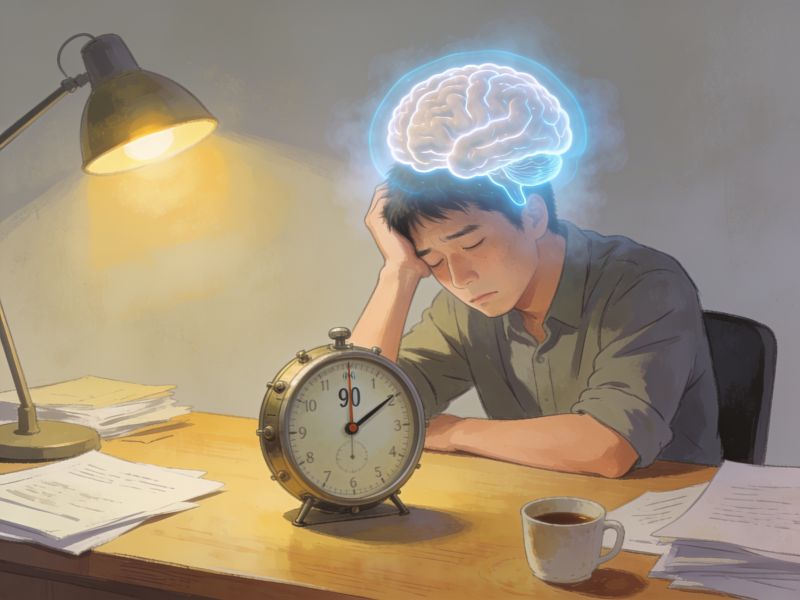
Fadiga doesn't announce itself with a loud alarm. It creeps in as mild irritation, then a sudden urge to check email, then a vague sense that everything is harder than it should be. I've tracked my own focus patterns for two years, and the pattern is brutally consistent: cognitive fadiga sets in at roughly 90 minutes of sustained attention, regardless of how motivated I feel. Pushing past that point without a break doesn't produce more work—it produces errors. A study from the Université de Bourgogne found that after 90 minutes of intense cognitive load。participants' performance on inhibition tasks dropped by 23%. They didn't notice the decline themselves. That's the dangerous part of fadiga: your self-assessment stays falsely positive while your actual output crumbles.Physical fadiga follows a different rhythm. After a long run, your muscles scream because lactate and hydrogen ions have accumulated faster than your body can clear them. But muscular fadiga has a clear signal—pain—that forces you to stop. Cognitive fadiga has no such alarm. You can keep typing。keep reading, keep pretending. I once spent an entire afternoon rewriting a report that, in hindsight, was better in its first draft. My brain was exhausted, but no pain receptors fired. The result was a slow, grinding decline in quality that felt like productive effort. That's why I now set a timer: 85 minutes of focus, then a 15-minute walk. Boring?Yes. Effective?The difference in my error rate is night and day.What actually works against fadiga isn't coffee or willpower. It's strategic disengagement. A five-minute break scrolling social media doesn't restore cognitive resources—it just shifts attention. Real recovery requires what researchers call "effortless attention": staring out a window, walking without a podcast, or doing something physically simple but mentally empty. I keep a chair by a window in my office for exactly this purpose. Ten minutes of watching traffic or trees resets my ability to concentrate far better than a caffeine hit. The science backs this up: attention restoration theory shows that natural environments—even urban ones viewed from a distance—replenish directed attention by engaging involuntary attention instead. Fadiga doesn't need to be fought. It needs to be managed with deliberate, low-stimulation pauses.
There's a cultural problem here. Most workplaces treat fadiga as a character flaw rather than a physiological state. I've seen managers praise employees who skip lunch to "push through" while quietly ignoring the fact that those same employees make twice as many mistakes by 4 p.m. Fadiga is not a sign of weakness;it's a signal that your brain's fuel gauge is empty. Ignoring it doesn't build toughness—it builds burnout. The best performers I know aren't the ones who work the longest. They're the ones who respect the 90-minute wall, take real breaks, and treat cognitive fadiga the way an athlete treats muscle fadiga: as data, not defeat. Your brain will hit the wall. Plan for it. The work you produce after a break will embarrass the work you forced through.